
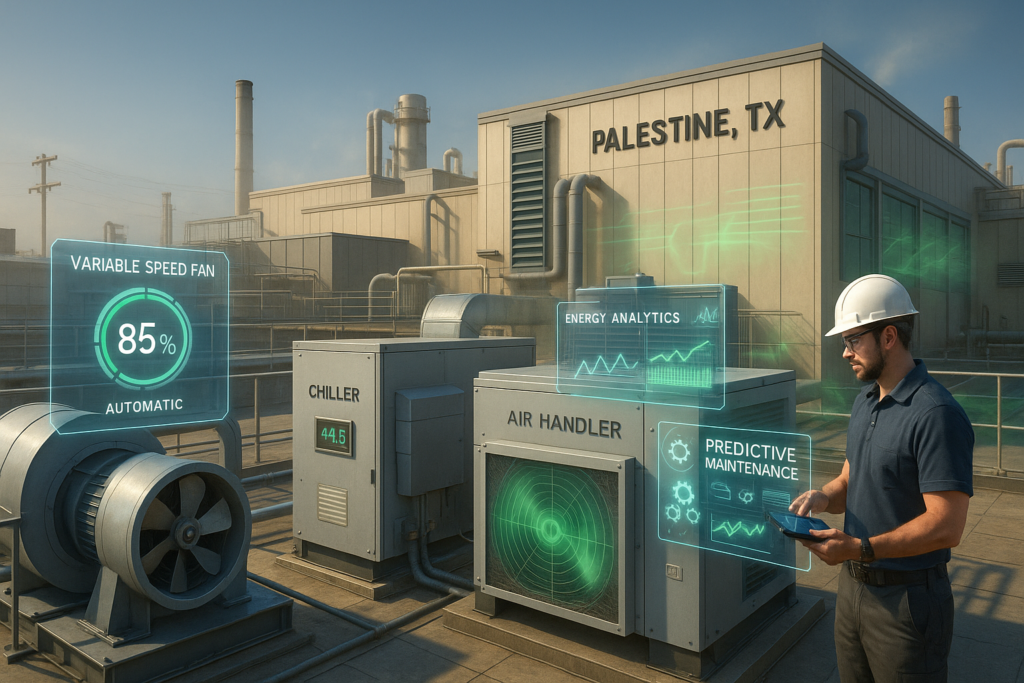
Why Smart Industrial HVAC Solutions Matter More Than Ever
In our town of Palestine TX, we feel the impact of Texas heat on industrial facilities every single day. When large buildings run outdated or poorly tuned HVAC systems, energy costs explode and comfort plummets. We have seen plants, warehouses, and manufacturing facilities spend tens of thousands of dollars a year on energy that simply doesn’t need to be used. That is exactly where smart industrial HVAC solutions quietly transform the picture.
Instead of relying on guesswork or fixed schedules, today’s systems can sense, learn, and automatically respond to what your facility actually needs. From air handlers to chillers, rooftop units to exhaust systems, every component can be optimized. Our passion is helping local businesses in Palestine TX use smart controls, data, and better design to cut energy waste, extend equipment life, and keep people safe and productive.
What makes these systems so powerful is that they work behind the scenes. Smart industrial HVAC solutions don’t demand attention once they are set up correctly; they simply keep trimming energy use hour after hour. When we retrofit or design systems with intelligence built in, our customers often see energy savings of 20–40% without sacrificing comfort or process control. Over time, those savings add up to massive reductions in operating costs and a stronger bottom line.
If you operate a facility with high internal heat loads, extensive ductwork, or many different temperature zones, there is almost always hidden waste that can be recaptured. By combining smart controls, efficient equipment, and proper maintenance, we turn your HVAC system into a strategic asset instead of just a necessary expense. The best part? Much of this can be done step by step, without disrupting your operations.
How Smart Controls Quietly Trim Your Energy Use
When we talk about smart industrial HVAC solutions, we are really talking about giving your system a brain. Instead of equipment switching on and off strictly on time clocks or manual settings, everything is coordinated through intelligent controls. In industrial facilities across Palestine TX, this can mean the difference between outdated, energy-hungry operation and a streamlined, responsive system.
From Manual Adjustments to Automated Precision
In many plants, someone still walks over to a thermostat, flips a switch, or manually changes a setpoint when they feel hot or cold. That approach leads to:
– Overcooling or overheating large spaces
– Conflicting temperature settings in different areas
– Fans and pumps running when nobody is present
– Constant wear and tear on compressors and motors
Smart controls replace these guesswork-based adjustments with automated, data-driven decisions. We have installed systems where sensors monitor:
– Temperature and humidity
– Occupancy and production schedules
– Equipment status and run-hours
– Outdoor weather conditions
Using this information, the control system can:
1. Adjust setpoints based on actual occupancy and production.
2. Stage compressors, fans, and pumps instead of running everything at full blast.
3. Limit peak demand by coordinating when equipment cycles on.
4. Maintain tighter, more stable conditions for both people and processes.
Over time, the control logic “learns” the building’s behavior—how long it takes to cool a line, how heat loads vary by shift, and how outdoor conditions affect indoor temperatures. In our experience, that leads to comfort that feels smoother while the utility bill quietly drops.
Demand Control, Zoning, and Scheduling
Three of the most effective control strategies we use in industrial HVAC solutions are demand control, zoning, and smart scheduling.
Demand control:
With demand control, we monitor carbon dioxide levels, airflow, and occupancy. Ventilation and conditioning are increased only when needed. For example, a warehouse loading dock may have high ventilation when trucks are coming and going, and much lower airflow at night. This prevents the system from conditioning large volumes of outdoor air unnecessarily.
Zoning:
Industrial buildings in Palestine TX often have very different needs in different areas:
– Production lines with heavy machinery
– Office areas requiring tighter comfort control
– Storage spaces needing simple temperature limits
– High-bay warehouses with stratified air
By creating zones with dedicated sensors and control valves or dampers, we send heating and cooling only where it is necessary. This zoning reduces over-conditioning of low-use areas and can dramatically cut run time on central units.
Smart scheduling:
Many facilities operate in shifts. We use scheduling features so the system “wakes up” just early enough to reach setpoints before workers arrive and then scales back after they leave. For weekends or holidays, automated setback modes keep temperatures within safe ranges but avoid full conditioning.
When we combine these control strategies, we often see comparable comfort with far less equipment run time. That is the essence of smart industrial HVAC solutions: better control, less waste, and smoother operation with little need for constant manual oversight.
Energy-Saving Hardware Upgrades That Pay You Back
Controls are powerful, but the equipment itself still has to do the work. In older industrial facilities across Palestine TX, we regularly find oversized or inefficient units that burn through electricity and gas. By targeting key components for upgrade, we align the hardware with the intelligence of smart controls and unlock even bigger savings.
High-Efficiency Equipment and Variable-Speed Technology
The days of “on/off only” equipment are fading. Variable-speed technology has changed how we design industrial HVAC solutions. Instead of a motor running at 100% or not at all, variable-speed drives (VFDs) let us modulate fans, pumps, and compressors.
Benefits of variable-speed equipment include:
– Reduced energy use during partial load conditions (which is most of the time).
– Less wear and tear from smooth ramp-ups instead of hard starts.
– Quieter operation, which is a big plus in already noisy industrial environments.
– Finer control over airflow and temperature.
We often upgrade:
– Supply and return fan motors with VFDs.
– Pump motors for chilled water and hot water systems.
– Compressors in packaged rooftop units or chillers, where appropriate.
In Palestine TX, where cooling loads are high for much of the year, variable-speed compressors can make a noticeable difference in kWh consumption. When paired with high-efficiency units that have better heat exchangers and refrigerant circuits, the savings become even more impressive.
Heat Recovery, Economizers, and Better Distribution
Another powerful group of upgrades focuses on capturing and using energy that would otherwise be wasted.
Heat recovery:
Industrial processes and exhaust air often carry significant heat. Heat recovery systems can:
– Transfer heat from exhaust air to incoming fresh air in colder seasons.
– In some cases, capture process heat to preheat water or other fluids.
This means you use less fuel or electricity to reach the same conditions inside the building.
Economizers:
On cooler days and nights, especially during spring and fall in Palestine TX, we can use outdoor air to cool the building instead of running compressors. Economizer dampers automatically open to bring in more cool outdoor air when conditions are right, and close when they are not. When calibrated properly, this “free cooling” can cut compressor run-time significantly.
Improved air distribution:
Even the best equipment wastes energy if air distribution is poor. We look for:
– Leaky ducts in unconditioned spaces.
– Poorly insulated ductwork causing temperature loss.
– Imbalanced airflow leading to hot and cold spots.
– Blocked or poorly placed diffusers.
By sealing ducts, improving insulation, and rebalancing the system, we reduce the amount of conditioning needed to keep spaces comfortable. It’s not flashy, but in many industrial buildings, fixing the distribution system is one of the fastest payback improvements.
We also recommend looking at up-to-date guidance and case studies from organizations like the U.S. Department of Energy’s Advanced Manufacturing Office and ENERGY STAR for Industry, which offer detailed benchmarks and tools for industrial facilities (https://www.energy.gov/eere/amo/advanced-manufacturing-office). Combining these best practices with local expertise here in Palestine TX gives our customers a strong roadmap for step-by-step upgrades.
Using Data and Monitoring to Keep Savings Rolling
Smart industrial HVAC solutions do not stop at installation. The real magic happens when we continue to watch how the system behaves over time. In our work with industrial clients around Palestine TX, we’ve seen huge benefits from adding monitoring and analytics to HVAC systems.
Real-Time Monitoring and Trend Analysis
Modern control platforms can collect data from every part of your HVAC system:
– Temperatures, humidity, and pressure
– Equipment run times and cycling patterns
– Energy use by unit or zone
– Alarms and fault codes
We use this data to build a picture of how your system behaves over days, weeks, and seasons. Real-time dashboards show whether conditions stay within desired ranges and whether any units are working harder than they should.
Trend analysis helps us answer questions like:
– Are compressors short-cycling, causing unnecessary wear?
– Do certain zones consistently call for more cooling or heating?
– Is energy use rising even when production stays flat?
– Are there specific times of day when demand spikes?
Once we see patterns, we can fine-tune setpoints, schedules, and sequences to remove energy waste while keeping comfort and process conditions stable. This continuous tuning is one of the quiet ways industrial HVAC solutions keep bills low over the long term.
Predictive Maintenance and Fault Detection
Another powerful benefit of monitoring is predictive maintenance. Traditional maintenance often waits for visible problems:
– Units failing in the middle of a shift
– Coils so dirty airflow is clearly restricted
– Bearings screeching before anyone calls for service
With smarter systems, we can catch issues earlier. We look for signs such as:
– Gradual increases in energy use for the same output
– Temperatures drifting out of normal ranges
– Excessive run times compared to similar units
– Repeated alarms or minor fault codes
These signs often appear days or weeks before a breakdown. By addressing them early, we:
– Prevent unplanned downtime.
– Extend equipment life.
– Maintain peak efficiency.
– Protect sensitive production processes and inventory.
For example, if a rooftop unit in Palestine TX begins to use more power to deliver the same cooling, it may indicate a dirty coil, refrigerant issue, or failing fan motor. Instead of waiting for a failure during the hottest day of summer, we schedule a focused service visit, fix the root cause, and keep things running smoothly.
Industrial customers appreciate that predictive maintenance often pays for itself through:
– Fewer emergency calls.
– Reduced overtime for maintenance staff.
– Lower replacement costs.
– Sustained energy savings.
Data-driven maintenance turns HVAC from a constant headache into a manageable, predictable part of your operation. It is one more way that industrial HVAC solutions add quiet but powerful value to facilities in Palestine TX and beyond.
Practical Steps to Start Saving in Your Palestine TX Facility
We know that when you run a plant, warehouse, or industrial facility, you have to balance production goals, safety, and budgets. It can feel overwhelming to think about major HVAC changes. That is why we prefer a practical, step-by-step approach to implementing smart industrial HVAC solutions, especially here in Palestine TX where many buildings have been expanded or modified over time.
Assess, Prioritize, and Plan
The first step is understanding where you stand today. We typically start with a structured assessment that includes:
– Reviewing your recent utility bills to identify trends and spikes.
– Walking the facility to observe equipment conditions and layouts.
– Talking with your maintenance team about recurring issues.
– Checking control settings, schedules, and setpoints.
From this assessment, we identify:
– Low-cost, quick-win changes (like schedule adjustments, minor repairs, or setpoint tweaks).
– Medium investments with strong payback (like adding VFDs, improving zoning, or upgrading controls).
– Long-term upgrades (like replacing central equipment nearing end-of-life).
By prioritizing these items, you get a clear roadmap rather than a random list of projects. In our experience, when facility managers see the potential savings and improved reliability laid out clearly, it becomes much easier to get internal support and budget approvals.
Start Small, Prove the Value, Then Expand
You do not have to upgrade everything at once. We often recommend:
– Piloting smart controls on a specific air handler or a defined zone.
– Adding monitoring to a few key units to understand performance.
– Upgrading one or two pieces of equipment that are known energy hogs.
Once you see the energy savings and improved comfort in one part of the facility, it builds confidence to expand the project. For example, in a distribution center near Palestine TX, we began with zoning and controls for the office wing and loading docks. After the customer saw energy use drop and comfort improve, we moved on to the main warehouse and then to process areas.
This phased approach minimizes disruption and spreads capital costs over time. It also lets your staff get comfortable with new systems. Our goal is to make sure operators and maintenance teams are trained and confident using the new controls and tools.
To explore more technical best practices and case studies on improving industrial HVAC efficiency, you can also review resources from ENERGY STAR for industrial plants at https://www.energystar.gov/industry. Combining these guidelines with local, hands-on support gives the best results.
Partnering with a Local Expert Team
Every industrial facility is unique. Roof heights, internal loads, safety requirements, and process needs vary widely. That is why working with a local team that understands both industrial HVAC solutions and the specific climate challenges of Palestine TX is so valuable.
When we work with industrial clients, we focus on:
– Listening carefully to production, safety, and comfort priorities.
– Designing solutions that integrate with existing systems when possible.
– Providing clear cost-benefit analysis for each recommended step.
– Supporting your team with training and ongoing service.
Our passion is turning HVAC from a constant cost into a controlled, optimized part of your operation. Whether you run a manufacturing line, cold storage, a logistics center, or a mixed-use industrial park, there is almost always room for improvement.
If you are ready to explore what smart industrial HVAC solutions could do for your facility in Palestine TX, we invite you to reach out to us. We are available to discuss your goals, review your current systems, and develop a customized plan to cut your energy bills quietly and effectively. You can contact us directly through our website at https://qualitycoolairetx.com/ so we can help you create a smarter, more efficient, and more comfortable facility.