
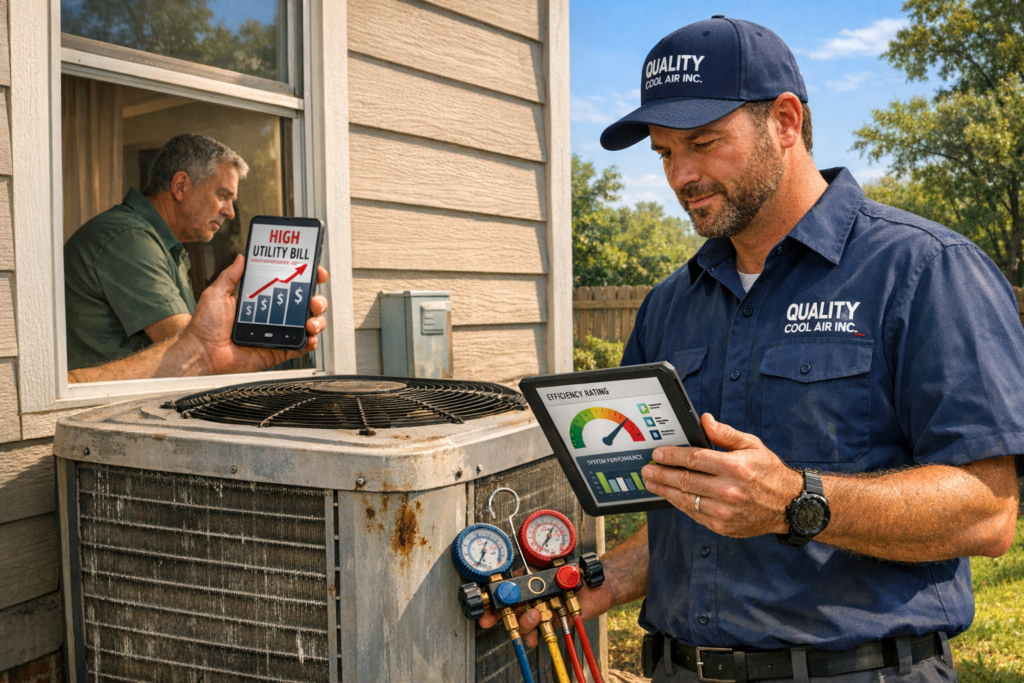
If your AC has been limping along for years, it may not be “doing fine” as much as it’s quietly draining your wallet. We see it all the time in Palestine, TX: a system that still turns on, but runs longer, cools unevenly, and pushes high energy bills higher every season. The worst part is that the waste is easy to miss—until a breakdown forces a rushed decision.
In this guide, we’ll show you the real-world signs you need an HVAC replacement, how to weigh HVAC repair vs replacement without guesswork, and how to plan HVAC system replacements that actually reduce stress and lower utility bills. We’ll also explain what drives HVAC replacement cost, what a proper HVAC installation should include, and how to choose energy‑efficient HVAC systems that fit your home and your budget.
1) The “quiet” ways an old AC drains your wallet in Palestine, TX
An aging system doesn’t have to fail spectacularly to cost you money. In fact, the most expensive problems are often the subtle ones—long run times, comfort issues you work around, and small repairs that add up. In our town, summer humidity and long cooling seasons can magnify inefficiency fast, especially with central air conditioning that’s past its prime.
Long run times, high energy bills, and creeping comfort problems
When a system loses efficiency, it compensates by running longer. That’s one of the most common reasons homeowners call us about high energy bills. You may not notice a dramatic change week to week, but month over month it’s obvious: the thermostat setting stays the same, yet the bill rises.
Here are a few “quiet” warning flags we look for during service calls:
– Longer cycles and fewer shutoffs, especially during mild afternoons
– Inconsistent heating and cooling from room to room
– Humidity that feels sticky even when the temperature looks right
– A home that never quite reaches the set point on hotter days
– A system that needs more frequent HVAC maintenance just to keep up
Those comfort issues aren’t just annoying—they’re expensive. When your AC can’t remove humidity effectively, you tend to drop the thermostat lower for relief, which drives up runtime and cost. That’s why home comfort and energy use are tied together.
Small repairs that become a pattern (and what they usually mean)
We’re big believers in smart repairs when they make sense. But once you’re seeing a pattern—capacitors, contactors, refrigerant-related issues, motor failures—you’re often approaching HVAC unit replacement territory. Repeating repairs can be a sign the system is near the end of its HVAC system lifespan, especially when parts are wearing out due to age and strain.
If you’re paying for multiple repairs per year, it’s time to step back and compare that spending to the long-term value of a new HVAC system. In many cases, HVAC system replacements aren’t about “wanting something new.” They’re about stopping ongoing losses that don’t show up as a single line item.
2) Signs you need an HVAC replacement (and how we confirm it)
Homeowners often ask us, “How do I know it’s really time?” We don’t guess—we verify. When we evaluate signs you need an HVAC replacement, we look at performance, safety, reliability, and total cost of ownership. The goal is to help you make a decision you’ll feel good about five years from now, not just today.
Age and HVAC system lifespan: the baseline reality check
Most systems have a practical HVAC system lifespan, and in East Texas climate conditions, wear can show up earlier if maintenance has been inconsistent. Age alone isn’t the only factor, but it sets expectations. As components degrade, efficiency drops and breakdown risk rises.
Common “replacement conversations” start when:
– Cooling equipment is 10–15+ years old and struggling
– Heating equipment is 15–20+ years old and needs frequent repairs
– A system uses older refrigerant types that are expensive or hard to source
– Comfort complaints increase despite regular HVAC maintenance
When you combine age with performance issues, the case for residential HVAC replacement becomes much clearer.
Performance tests and red flags we see during diagnostics
We confirm the need for air conditioning replacement or heating upgrades by measuring what the system is actually doing, not what we hope it’s doing. If your system can’t meet demand without excessive runtime, you’re paying for wasted electricity.
Practical red flags include:
– Temperature split that’s outside normal operating ranges
– Airflow problems caused by duct restrictions or blower decline
– Dirty or leaking evaporator coils that reduce capacity
– Compressor strain and hard starts
– Frequent frozen coils, often tied to airflow or refrigerant issues
– Persistent inconsistent heating and cooling that points to sizing or duct problems
We also consider indoor air quality. An older system may not filter well, may struggle with humidity control, and may circulate dust more easily—especially if ductwork and filtration haven’t been updated. Better filtration, airflow balancing, and modern controls can make a noticeable difference in indoor air quality and daily home comfort.
3) HVAC repair vs replacement: a step-by-step way to decide without pressure
The HVAC repair vs replacement decision gets emotional because nobody wants a surprise expense. We understand that. Our job is to make it logical. When we walk homeowners through HVAC system replacements, we show the math, the risk, and the comfort improvements side by side.
A practical cost comparison you can use today
Start by listing what you’ve spent recently and what you’re likely to spend next. Then compare it to expected savings and reliability improvements from HVAC system replacements. The exact HVAC replacement cost varies, but the decision framework stays the same.
We recommend using these checkpoints:
1. Add up repair totals for the last 24 months (parts + labor + service calls).
2. Estimate near-term repairs you’re expecting (for example, leak searches, motor replacements, or control boards).
3. Evaluate comfort costs: rooms you can’t use, thermostat battles, and poor humidity control.
4. Consider efficiency: an older system may be dramatically less efficient than a new HVAC system with a strong SEER2 rating.
5. Factor in risk: emergency breakdowns usually mean fewer choices and faster decisions.
If you’re consistently paying to keep the system running and still dealing with comfort complaints, HVAC unit replacement is often the financially smarter path.
How efficiency (SEER rating / SEER2 rating) changes the long-term picture
Efficiency is where many homeowners see the biggest change after a quality HVAC installation. The SEER rating / SEER2 rating indicates cooling efficiency; higher numbers typically mean less energy used for the same cooling output. In Palestine, TX, where AC use is heavy, moving to energy‑efficient HVAC systems can translate into lower utility bills you can feel.
A new HVAC system can also include:
– Variable-speed blowers for smoother temperature control
– Improved humidity management for better home comfort
– Smarter thermostats and zoning options
– Quieter operation and more consistent airflow
We also remind people that efficiency only pays off when installation is done correctly. A high SEER2 rating won’t perform as advertised if ductwork is leaky, airflow is wrong, or the system is improperly sized.
For independent efficiency standards and updates, we often point homeowners to the U.S. Department of Energy guidance: https://www.energy.gov/energysaver/air-conditioning
4) What drives HVAC replacement cost—and how we help you control it
People deserve honest answers about HVAC replacement cost. The truth is, there isn’t one universal number, because homes and buildings vary. But the factors behind pricing are predictable, and when you understand them, you can control the parts that are within your reach.
When Quality Cool Air Inc builds a plan for HVAC system replacements, we focus on right-sizing, long-term reliability, and comfort—not just swapping boxes.
The biggest pricing variables (and what’s worth paying for)
Here’s what most directly impacts HVAC replacement cost:
– System type: straight cool + furnace replacement, heat pump replacement, or packaged systems
– Capacity and sizing: oversized systems short-cycle and struggle with humidity; undersized systems run nonstop
– Efficiency level: higher SEER2 rating equipment can cost more upfront but may produce lower utility bills over time
– Ductwork condition: repairs, sealing, or modifications for airflow
– Electrical and safety updates: disconnects, breakers, and code requirements
– Indoor air quality upgrades: filtration, UV options, and dehumidification add-ons
– Job complexity: attic access, tight closets, roof curbs for commercial HVAC replacement
We’ve found that spending wisely on correct sizing and airflow is one of the best ways to protect your investment. A cheap HVAC installation that ignores ducts and static pressure can lead to noise, breakdowns, and inconsistent heating and cooling—even with brand-new equipment.
Residential and commercial considerations in East Texas
For residential HVAC replacement, homeowners usually want predictable comfort, quiet operation, and manageable operating costs. For commercial HVAC replacement, building owners often prioritize uptime, zoning, and serviceability. Either way, we treat HVAC installation as a system—not just equipment.
In both residential and commercial settings, we look at:
– Load calculations (not guessing by square footage alone)
– Duct or ventilation requirements
– Thermostat and control strategy
– Condensate drainage and overflow protection
– Maintenance access for future HVAC maintenance visits
When you plan instead of panic, you can often make better decisions on equipment and timing. That’s also where HVAC financing options can help. If the best long-term choice is a higher-efficiency new HVAC system, spreading the investment out can keep cash flow comfortable while you start benefiting from lower utility bills.
If you’re comparing options, we can provide a free HVAC replacement estimate so you can see the numbers clearly before you commit.
5) Getting HVAC system replacement in Palestine TX right: our process for comfort, air quality, and reliability
A great outcome depends on more than buying a new HVAC system. The difference between “installed” and “installed correctly” is huge. When people call us after a disappointing experience elsewhere, the problems often trace back to shortcuts: poor airflow setup, sloppy drainage, incorrect refrigerant charge, or duct leaks left unaddressed.
We built our approach at Quality Cool Air Inc to prevent those issues and deliver lasting home comfort.
What a quality HVAC installation should include
Whether it’s air conditioning replacement, furnace replacement, or heat pump replacement, we believe a professional HVAC installation should cover:
– Proper sizing and load evaluation for the building
– Verification of duct condition, airflow, and static pressure
– Correct refrigerant charging and performance testing
– Safe electrical work and code-compliant connections
– Condensate management to prevent water damage
– Thermostat setup and homeowner walk-through
We also discuss indoor air quality early. Better filters, improved return airflow, and optional enhancements can reduce dust and help your system run more efficiently. Indoor air quality isn’t just a “nice to have”—it affects comfort, allergies, and how clean the home feels day to day.
Why licensed HVAC technicians and ongoing maintenance matter
We encourage homeowners and business owners to work with licensed HVAC technicians because correct installation and safe operation matter. Gas heating, high-voltage components, refrigerant handling, and airflow setup all require skill and accountability.
After HVAC system replacements, consistent HVAC maintenance is what protects the investment. We typically recommend:
– Spring tune-ups before heavy cooling season
– Fall inspections before heating season
– Filter changes on a schedule that matches your home and lifestyle
– Keeping outdoor units clear and drains flowing
Good HVAC maintenance helps preserve efficiency, supports indoor air quality, and reduces surprise breakdowns. It’s one of the simplest ways to keep home comfort stable year after year.
When you’re ready, we can also provide a free HVAC replacement estimate and help you compare equipment options based on your goals—not sales pressure.
6) What to do next: plan your replacement, reduce your bills, and regain comfort
If your old system is costing you in repairs, comfort, and high energy bills, you don’t have to wait for a total breakdown to act. We’ve found that the best results come when homeowners plan HVAC system replacements on their terms: selecting the right system type, targeting a strong SEER rating / SEER2 rating, and making sure the HVAC installation addresses airflow and duct issues.
Here are the key takeaways we want every homeowner and business owner to remember:
– If you’re seeing multiple signs you need an HVAC replacement, it’s worth evaluating now
– HVAC repair vs replacement becomes clearer when you compare repeat repair costs with reliability and efficiency gains
– HVAC replacement cost is driven by system type, sizing, ductwork, and efficiency—so ask for a clear scope
– Energy‑efficient HVAC systems can improve indoor air quality, reduce noise, and deliver better home comfort
– Ongoing HVAC maintenance protects your new system and helps maintain lower utility bills
If you want help choosing the right path—air conditioning replacement, furnace replacement, heat pump replacement, or a full new HVAC system—our team at Quality Cool Air Inc is here for Palestine, TX and surrounding areas with East Texas HVAC services you can trust. Schedule your free HVAC replacement estimate and talk through options with our licensed HVAC technicians here: https://qualitycoolairetx.com/