
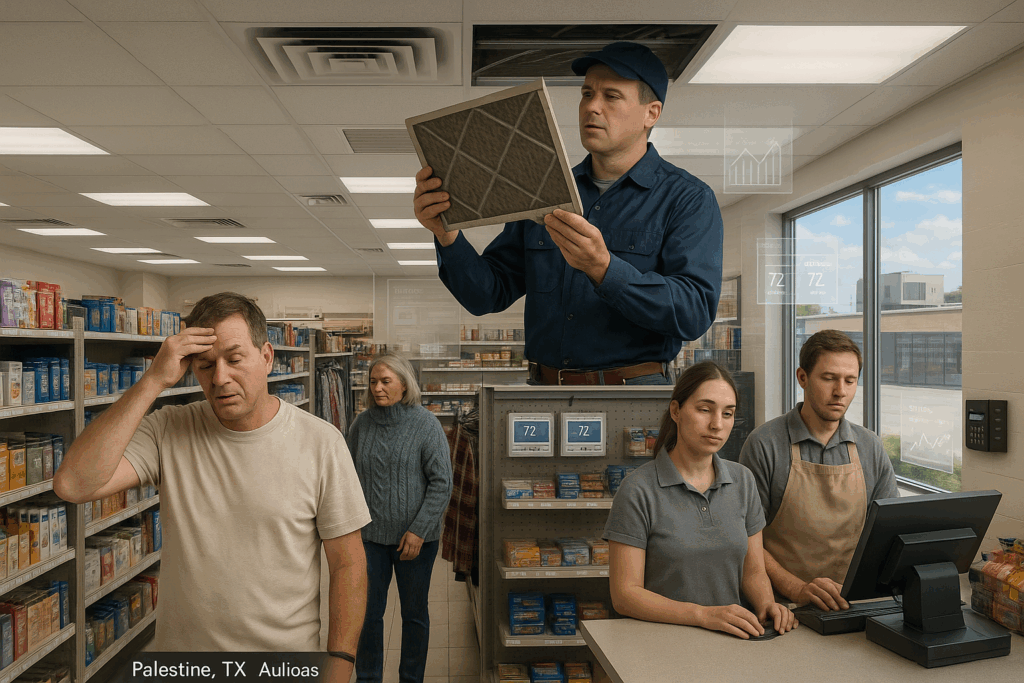
Why Hidden HVAC Problems Are Silently Draining Retail Profits
Running a profitable retail store in a town like Palestine TX is already a balancing act. We work hard to control inventory, staffing, marketing, and utilities, but one of the most overlooked profit-killers is sitting quietly above our heads: the retail HVAC system. When our heating and cooling equipment isn’t working exactly as it should, it doesn’t always fail in a dramatic way. Instead, it slowly wastes money month after month through higher energy bills, lost sales, and reduced customer loyalty.
We have seen many local retailers assume that as long as the air is “not too hot and not too cold,” everything is fine. In reality, even minor HVAC issues can create hot and cold spots, uncomfortable humidity, and stale air that drives customers out sooner and keeps staff productivity down. The hidden costs add up in ways that don’t always show up on an obvious line item, but they absolutely show up in the bottom line.
When we look closely at retail HVAC in Palestine TX, we notice the same common patterns: systems are oversized or undersized, filters are neglected, ductwork leaks, and thermostats are programmed poorly. None of these problems seems catastrophic on its own, yet together they can add hundreds or thousands of dollars in avoidable costs each year. By understanding how these “invisible” issues steal profit, we can turn our HVAC system from a quiet liability into a dependable asset.
How Hidden HVAC Issues Eat Into Retail Revenue
We often think of HVAC costs purely as the utility bill, but in retail, the financial impact is much wider. In our experience, hidden HVAC issues affect three major profit areas: operating expenses, sales performance, and asset life. When we connect the dots, we realize our building’s comfort system is as much a business tool as our point-of-sale system.
1. Rising Energy Bills That Seem “Normal”
Most of us expect energy costs to creep up over time, especially during hot summers in Palestine TX. That’s why it’s so easy to miss when our retail HVAC is quietly wasting power. A system can still cool and heat the space, yet consume 10–30% more energy than it should.
Common causes include:
– Dirty or clogged filters that force the system to work harder
– Refrigerant charge that’s slightly off, lowering efficiency
– Failing or dirty condenser and evaporator coils
– Worn belts, bearings, or motors causing inefficiency
– Leaky ducts spilling conditioned air into ceilings or unused spaces
Each of these problems might only add a few dollars per day, but over a long Texas cooling season, that can mean hundreds or thousands of dollars lost. Without routine, data-driven maintenance, we often just accept higher bills as “the cost of doing business,” instead of recognizing them as preventable waste.
2. Lost Sales From Uncomfortable Shopping Conditions
We all know what it feels like to walk into a store that’s stuffy, overly warm, or drafty. We spend less time browsing and more time trying to get out. Our customers feel the same way, and in a competitive retail landscape, comfort can be the difference between a quick walkthrough and a full basket.
Hidden HVAC issues that directly impact sales include:
– Hot or cold spots in certain aisles or departments
– Humidity that makes the air feel heavy, sticky, or musty
– Excessive noise from rattling units or high-speed fans
– Odors from dirty coils, stagnant condensate pans, or mold in ducts
When we talk to local store managers, many admit they see customers pull on sweaters in frozen aisles or wipe sweat off their foreheads in poorly cooled sections. Those subtle signs translate into customers cutting trips short, avoiding certain departments, or choosing to shop elsewhere in Palestine TX where the environment feels better.
Studies from retail consulting groups frequently show that dwell time correlates strongly with sales volume. If our HVAC system is quietly driving people away faster, we’re losing money without a single alarm going off on our equipment.
3. Higher Employee Turnover and Lower Productivity
Staff comfort and morale are just as critical as customer comfort. Our team members spend long hours on their feet, moving between stockrooms, sales floors, and checkout areas. If our retail HVAC system can’t maintain a stable, comfortable environment, employees get tired faster and feel more stressed.
Subtle impacts include:
– More breaks to “cool off” or “warm up”
– Lower focus and slower service when they’re uncomfortable
– More sick days in environments with poor air quality or uneven temperatures
– Higher turnover because the workplace feels physically demanding
We might not immediately link these HR issues to HVAC performance, but when we improve comfort, we often see morale go up and complaints go down. That translates into better customer service, fewer errors, and a more positive shopping experience that directly supports revenue.
4. Premature Equipment Failure and Emergency Repairs
Another way hidden HVAC problems hurt our bottom line is by shortening the life of expensive equipment. When systems run under stress—because of dirty components, improper airflow, or running schedules that never give them a break—they wear out long before their expected lifespan.
We’ve seen rooftop units fail years early simply because:
– Filters were never replaced on schedule
– Coils were never cleaned
– Economizers were stuck open or closed
– Fans ran 24/7 unnecessarily
Unexpected breakdowns often happen at the worst possible time: peak heat in Palestine TX, weekends, or busy retail seasons. Besides emergency repair costs, we risk closing the store, limiting hours, or operating with poor conditions that further damage sales and our reputation. What looks like a single mechanical failure often traces back to years of small, hidden issues that were never addressed.
The Most Common Hidden HVAC Problems in Retail Stores
To protect our retail profits, we first need to know what to look for. In our work with retail HVAC systems around Palestine TX, we repeatedly encounter a similar set of “silent” issues. They don’t always trigger alarms, but they slowly erode efficiency, comfort, and reliability.
1. Poor Air Distribution and Unbalanced Systems
A common complaint from store managers is: “The thermostat says 72, but half the store feels nothing like 72.” That’s often a sign of poor air distribution rather than an issue with the main equipment.
Typical culprits include:
– Blocked or misdirected supply registers
– Return grilles covered by displays or shelving
– Ductwork design that never matched the store’s current layout
– Damper positions that were never properly balanced
When air distribution is uneven, we end up with “problem zones” in the store: the front door feels like a wind tunnel, the center aisles are warm and stuffy, or the back corners are freezing. Our instinct is often to change the thermostat setting drastically, which only drives up energy use without addressing the root cause.
In Palestine TX, where seasonal temperature swings can be dramatic, proper air balancing is especially important. We have to ensure the air volume and direction match the way our store is actually used today, not how it was designed years ago.
2. Dirty or Neglected Components
Retail environments carry more dust, fibers, and debris than we might think. Cardboard boxes, clothing fibers, foot traffic, and product packaging all contribute to airborne particles that end up in our HVAC filters and coils.
Hidden maintenance-related problems include:
– Filters that look “okay” but are well past their optimal performance
– Evaporator coils coated in a thin film of dust and grime
– Condenser coils plugged up with cottonwood fluff, dirt, and grease
– Condensate pans full of slime, algae, or standing water
These conditions reduce heat transfer, lower efficiency, and can cause odors or microbial growth. The system might still cool the store, but it has to run longer and harder to achieve the same effect. Over time, this disguised overload stresses compressors and fans, while slowly raising energy bills.
3. Misconfigured or Aging Controls
Thermostats and building controls often get “adjusted” by multiple people over the years. Settings change, schedules get overridden, and sometimes equipment is replaced without reprogramming the controls correctly.
We frequently see:
– Units running outside of store hours because schedules are outdated
– Multiple thermostats fighting each other in different zones
– Improper use of setback temperatures that never allow the store to stabilize
– Older thermostats with inaccurate sensors
In retail HVAC systems, these control issues can add up to hundreds of unnecessary operating hours per year. That’s like leaving lights on in an empty store without realizing it. Smart controls, when set up properly, can quickly pay for themselves through more precise scheduling and better coordination across all units.
4. Inadequate Ventilation and Indoor Air Quality
Customers and employees may not always notice air quality directly, but they do notice headaches, stuffiness, and smells. Hidden ventilation problems can turn a clean-looking store into a place that just doesn’t feel inviting.
Common issues include:
– Exhaust fans that no longer work properly
– Outside air dampers stuck closed or wide open
– Incorrect ventilation rates for current store occupancy
– Filters with poor MERV ratings for the environment
Too little fresh air makes the space feel stale, while too much uncontrolled outside air drives up heating and cooling costs. In a climate like Palestine TX, balancing ventilation is crucial: we want enough outside air to keep the store fresh, but not so much that humidity or heat load gets out of control.
Smart Strategies to Protect Your Store From HVAC-Related Losses
Once we understand how our retail HVAC system can quietly drain profits, the next step is to put smarter strategies in place. The goal isn’t just to prevent breakdowns; it’s to align our HVAC operation with our business goals: comfortable customers, efficient energy use, and reliable performance through our busiest seasons.
1. Start With a Professional Retail HVAC Assessment
A thorough assessment is like an annual physical exam for our building. Instead of guessing what might be wrong, we get data-based insight into how our system is truly performing.
A quality assessment for a retail store should include:
– Measuring temperature and humidity in different areas of the store
– Inspecting supply and return air distribution
– Checking ductwork for leaks, damage, or poor design
– Evaluating current thermostat settings and schedules
– Inspecting filters, coils, fans, and electrical components
– Reviewing energy bills for abnormal patterns
In Palestine TX, local HVAC professionals who understand retail environments can also look at how our system handles peak summer demands, door traffic, and refrigeration loads if we have coolers or freezers on-site. With this information, we can prioritize improvements by cost, impact, and urgency rather than making random repairs.
2. Implement a Retail-Focused Preventive Maintenance Program
Generic maintenance plans often fail retail stores because they don’t account for actual hours of operation, foot traffic, or local conditions. We need a preventive maintenance schedule tailored to our specific retail HVAC usage.
Key elements of a strong program include:
– Filter changes based on environment and hours, not just a fixed calendar
– Seasonal coil cleaning before heavy cooling and heating periods
– Regular checking and cleaning of condensate systems
– Inspection and lubrication of motors, belts, and fans
– Verification and calibration of thermostats and sensors
– Airflow measurements and damper adjustments as needed
When we treat HVAC maintenance as a profit protection strategy instead of an annoying expense, the perspective changes. For many retailers in Palestine TX, one avoided emergency service call or one season of lower energy bills can cover the cost of a full year of planned maintenance.
3. Optimize Controls, Schedules, and Setpoints
We can often capture “low-hanging fruit” savings simply by dialing in how and when our retail HVAC equipment runs. Programmable thermostats and smart controls are powerful tools when configured properly.
Practical steps include:
– Align operating schedules with actual staffed and customer hours
– Use gradual setpoint changes before opening and after closing
– Avoid extreme setpoints that cause systems to short cycle or run constantly
– Coordinate zones so they don’t “fight” each other
– Lock or limit manual overrides to prevent constant tinkering
In a city like Palestine TX with hot summers and mild shoulder seasons, we can often take advantage of cooler mornings or evenings by adjusting schedules seasonally. The key is to review settings regularly instead of assuming they’re always correct.
4. Improve Air Distribution and Store Layout Synergy
Our merchandising and store layout can unknowingly sabotage our HVAC performance. When we redesign aisles or move fixtures, we sometimes block vents or change how air flows through the space.
To keep air distribution working with us instead of against us:
– Map all supply and return vents before moving major displays
– Avoid placing tall fixtures directly in front of vents or returns
– Check for drafts or dead zones after layout changes
– Consider diffusers or deflectors if certain areas are problematic
We have found that even small layout changes can make a big difference in perceived comfort. Partnering with a local retail HVAC expert when planning major remodels or remerchandising can save headaches and prevent costly performance issues down the road.
Why Retail HVAC Strategy Matters More in Palestine TX
Our local climate and community dynamics make HVAC performance especially important for retailers in Palestine TX. We’re not just dealing with temperature; we’re managing humidity, heat gain through windows, and fluctuating occupancy patterns throughout the week and year.
1. The Impact of East Texas Heat and Humidity
Summer in Palestine TX is not just hot; it’s humid. That humidity is a big part of why some stores feel sticky or “heavy” even when the thermostat looks okay. Our retail HVAC systems have to remove moisture from the air as well as heat, and if they’re not sized or maintained correctly for this dual job, comfort suffers and energy costs grow.
Humidity-related issues include:
– Fogging on glass doors or refrigerated cases
– Musty smells in carpets or stockrooms
– Customers complaining the store feels “muggy”
– Mold risks in poorly ventilated areas
When we fine-tune our systems for dehumidification—through proper airflow, equipment staging, and possibly reheat or dedicated dehumidification strategies—we protect both merchandise and customer experience. In a competitive retail market, a store that consistently feels fresh and pleasant has a serious advantage.
2. The Cost of Downtime and Reputation in a Small City
In a community like Palestine TX, word travels fast. If our store has repeated issues with being “too hot,” “too cold,” or having strange smells, customers will talk about it. We might not see online reviews immediately, but we definitely feel the impact in repeat business and word-of-mouth.
Key local realities include:
– High-traffic days during local events or seasonal sales
– Fewer alternative locations, meaning one bad experience stands out more
– Strong community relationships where comfort and hospitality matter
A severe HVAC failure on a key weekend can hurt not only that day’s sales, but also customer trust. By prioritizing retail HVAC reliability and comfort, we demonstrate that we value our customers’ experience as much as we value the products we sell.
3. Partnering With Local Experts Who Understand Retail Needs
Retail HVAC in Palestine TX is not a generic “one-size-fits-all” service. Our needs differ from office buildings, warehouses, or homes. Stores have doors opening constantly, varied occupancy, product-sensitive temperature zones, and long operating hours.
Working with an HVAC company that understands:
– Retail traffic patterns and door infiltration
– The interaction between refrigeration and comfort cooling
– Seasonal sales peaks and off-peak opportunities for maintenance
– The importance of protecting brand image and customer comfort
can make all the difference. Instead of reacting to breakdowns, we can plan upgrades, maintenance, and improvements around our business calendar, not the other way around. For more insights on HVAC system care and energy efficiency, resources like ENERGY STAR’s guide for small business are helpful starting points: https://www.energystar.gov/buildings/owners_and_managers/small_business.
Our passion is helping local retailers turn HVAC from a silent expense into a strategic advantage. When our systems are tuned, maintained, and aligned with our business goals, we don’t just save on utilities—we create a better shopping and working environment that supports long-term growth.
We’ve seen how hidden HVAC problems can quietly chip away at profits through higher energy bills, lost sales, stressed staff, and premature equipment failure. The good news is that we’re not stuck with these hidden losses. By understanding the common issues, taking a proactive approach to inspections and maintenance, and optimizing our controls and layout, we can bring these problems out of hiding and deal with them for good.
Our retail HVAC systems in Palestine TX should be working for us, not against us. With the right strategy and local expertise, we can keep our stores comfortable, our equipment reliable, and our profits stronger throughout the year.
If you’d like to uncover what your own store’s HVAC is really costing you—and how much you could save—we’re here to help. Visit https://qualitycoolairetx.com/ to get in touch, schedule a retail HVAC assessment, or talk with our team about a maintenance and optimization plan tailored to your store.